
Don’t wait until senior year
When Should You Start Applying for Scholarships?
One of the most common questions I get from parents is:
“When should my student actually start applying for scholarships?”
My answer?
Earlier than most families think.
You do not need to wait until senior year.
There are scholarship opportunities for students before then, and the earlier your student gets familiar with the process, the less overwhelming it feels later.
- Middle schoolAwareness
- 9th–10thAge / grade opportunities
- 11thBroaden the search
- 12thSearch actively
- CollegeKeep going
But if your student is already a junior, senior, or even in college, do not panic.
You have not “missed” scholarships.
There are different opportunities available at different ages and stages, and scholarship deadlines happen throughout the year.
So instead of worrying about whether you started at the perfect time, I would focus on this:
What can my student qualify for and apply for right now?
Then start there.
By Ryan Kelly, Founder of Scholarship Navigator
So, When Should Your Student Start?
If your student is old enough to qualify for a legitimate scholarship that makes sense for them, they can apply.
It really can be that simple.
I would not wait until:
- senior year
- college applications are finished
- the FAFSA is complete
- your student has chosen a college
- your student knows exactly what they want to major in
Those things may matter for certain scholarships.
They do not determine whether your student can begin looking.
Some scholarships are only for graduating seniors.
Others are open to juniors, sophomores, freshmen, younger students, current college students, or students at particular stages of their education.
That is why I would not treat scholarships like something that suddenly “starts” during senior year.
Looking for Scholarships and Applying for Them Are Two Different Things
This is especially important for younger students.
Your student may not qualify for a huge number of scholarships yet.
That does not mean there is nothing useful to do.
Looking
Learn what exists, notice eligibility, become familiar with opportunities
vs.
Applying
Pursue opportunities the student is actually eligible for now
For example, say your freshman finds a scholarship that is only open to juniors and seniors.
They obviously cannot apply yet.
But now you know:
- that organization offers a scholarship
- what grade levels it is open to
- roughly when the opportunity appears
- what the application asks for
That can be useful information later.
I would not build some giant spreadsheet of scholarships four years before your student can apply and assume all of them will still exist.
Scholarships change too much for that.
But there is real value in becoming familiar with what is out there before senior year suddenly arrives.
What I Would Focus on at Each Stage
Middle School
I would keep scholarships pretty low-pressure at this age.
There are some opportunities available to younger students, and if your student finds one that genuinely fits, there is nothing wrong with applying.
But I would not turn middle school into a full scholarship campaign.
At this age, I care much more about your student:
- discovering interests
- trying activities
- building skills
- taking on responsibility
- doing things they actually enjoy
Those experiences may become useful later, both for scholarships and for the student’s own growth.
If an appropriate scholarship or contest comes along?
Great. Apply.
If not?
You are not behind.
Freshman and Sophomore Year
By freshman and sophomore year, I would start paying more attention to scholarships, but I would keep the search fairly simple.
At these grade levels, a lot of the opportunities your student will find are scholarships, contests, or established programs that are specifically open to younger high school students.
Some are national opportunities. Others may begin through a local post, chapter, school, or organization and then progress beyond the local level.
So at this stage, I would mostly focus on:
- scholarships open to your student’s current age or grade
- established contests and programs that allow younger high school students
- opportunities your school counselor or school scholarship list specifically shares for younger students
I would not expect a freshman or sophomore to be doing the same kind of highly personalized scholarship searching I would recommend later.
For now, the goal is simply to find legitimate opportunities they can actually enter and start getting comfortable with the process.
Junior Year
Junior year is where I would start broadening the search quite a bit.
There are still plenty of opportunities that are simply open to juniors by grade level, but now I would also begin looking more intentionally at things connected to the student themselves:
- interests
- activities
- jobs
- volunteering
- experiences
- career goals
- possible major
- community
- other things that are actually true about them
Your student also usually has more to work with by this point:
- more activities
- more work or volunteer experience
- clearer interests
- stronger examples to write about
- maybe a better idea of what they want to study or do next
This is also when I would begin paying closer attention to scholarships the student may become eligible for during senior year.
One mistake I would avoid is assuming:
“We will worry about scholarships next year when college applications start.”
Scholarships and college applications are not the same timeline.
There may already be plenty your student can pursue.
Senior Year
If your student is a senior, I would start now.
Not “after college applications.”
Not “once we know where they are going.”
Not “sometime in the spring.”
Now.
Senior year is one of the biggest scholarship years simply because so many awards are specifically designed for graduating high school students.
And deadlines are all over the calendar.
Some will be in the fall.
Some in winter.
Some in spring.
Some later.
Every scholarship provider sets its own rules.
That is why I would keep looking throughout the year instead of assuming there is one short “scholarship season.”
Already in College?
Keep applying.
This is another place families sometimes stop too soon.
Once the student gets into college, they assume scholarships are over.
They are not.
College students can still find scholarships through:
- their college
- academic departments
- majors
- employers
- professional organizations
- community organizations
- outside scholarship providers
And your student may actually have more to work with now.
They may have a declared major, college activities, an internship, a job, new accomplishments, or a much clearer career direction.
So do not automatically stop looking once high school ends.
Why Starting Earlier Helps
The biggest advantage of starting earlier is not that younger students somehow have a guaranteed better chance of winning.
It is simply that you have more time.
More time to find opportunities.
More time to get comfortable applying.
More time to improve essays and responses.
More time to learn what kinds of scholarships are worth pursuing.
And more time to keep going after a rejection instead of feeling like everything depends on one application.
I started applying for scholarships before senior year myself, and looking back, I wish I had understood the process even earlier.
The sooner scholarships become a normal part of your family’s college-planning conversation, the less they feel like one huge project you suddenly have to figure out during senior year.
What If My Student Is Already a Junior or Senior?
Then please do not spend too much time wishing you had started earlier.
I see parents do this all the time.
They realize scholarships were available before senior year and immediately think:
“Oh no. We are behind.”
Maybe you could have started sooner.
That does not change what your student can do today.
If they are a junior, start looking.
If they are a senior, start looking.
If they are already in college, start looking.
The useful question is not:
“When should we have started?”
It is:
“What opportunities are available to my student now?”
That is where I would put your energy.
Scholarships Do Not All Have the Same Deadline
Another misconception is that there is one scholarship season.
There really isn’t.
Different organizations run scholarships on completely different calendars.
One scholarship may close in October.
Another in January.
Another in March.
Another in June.
A local scholarship might open for only a short period through your student’s school.
A professional organization might use an entirely different schedule.
This is why I would never wait for some imaginary point in the year when it is officially “time” to look for scholarships.
There are opportunities throughout the year.
The important thing is checking the actual provider’s current deadline and requirements.
Starting Early Does Not Mean Applying to Everything
This is where I want to make an important distinction.
Starting sooner does not mean I want your student submitting applications to every scholarship they can find.
I still want you asking:
- Is my student actually eligible?
- Does this scholarship make sense for them?
- Is the opportunity current?
- Who is offering it?
- Is this worth the time the application will take?
Starting earlier gives you more opportunities to choose from.
It should not mean wasting more time.
If you need help with where worthwhile scholarships are actually hiding, that is exactly what I cover in How to Find Scholarships.
What Should My Student Do Right Now?
Middle school?
Stay aware of age-appropriate opportunities and contests.
Apply when something genuinely fits.
Do not make scholarships stressful.
Freshman or sophomore?
Look primarily for scholarships and established programs that are open to your student’s age or grade.
Start learning the process without overcomplicating the search.
Junior?
Increase the search and begin expanding beyond grade-based opportunities into scholarships connected to the student’s interests, activities, experiences, goals, and other qualifications.
Senior?
Search broadly and actively.
Do not wait, and keep looking throughout the year.
Already in college?
Keep going.
Look through the college itself and continue searching by major, career field, work experience, organizations, and other student-specific factors.
You do not need the perfect starting point.
You just need to begin with the opportunities your student can actually pursue today.
You Do Not Need Everything Figured Out First
Sometimes parents assume their student cannot really start scholarships yet because:
- they do not know their major
- they have not chosen a college
- they have not completed the FAFSA
- they have never written a scholarship essay
- they do not have an impressive résumé
None of those things means you have to wait across the board.
They may matter for a particular scholarship.
If they do, follow that scholarship’s rules.
Otherwise, start with what your student already knows, already does, and already qualifies for.
The process can grow with them.
Keep Going From Here
Not sure where to actually find scholarships?
How to Find ScholarshipsLearn where worthwhile scholarships can be found and how to go beyond the same giant databases most families rely on.→Ready to start applying?
How to Apply for ScholarshipsLearn how to prepare, organize, reuse, adapt, review, and submit applications without starting from scratch every time.→Is the essay the part your student is stuck on?
Scholarship Essay HelpLearn how to answer the prompt, use real experiences, write a stronger opening, and keep the student’s own voice.→
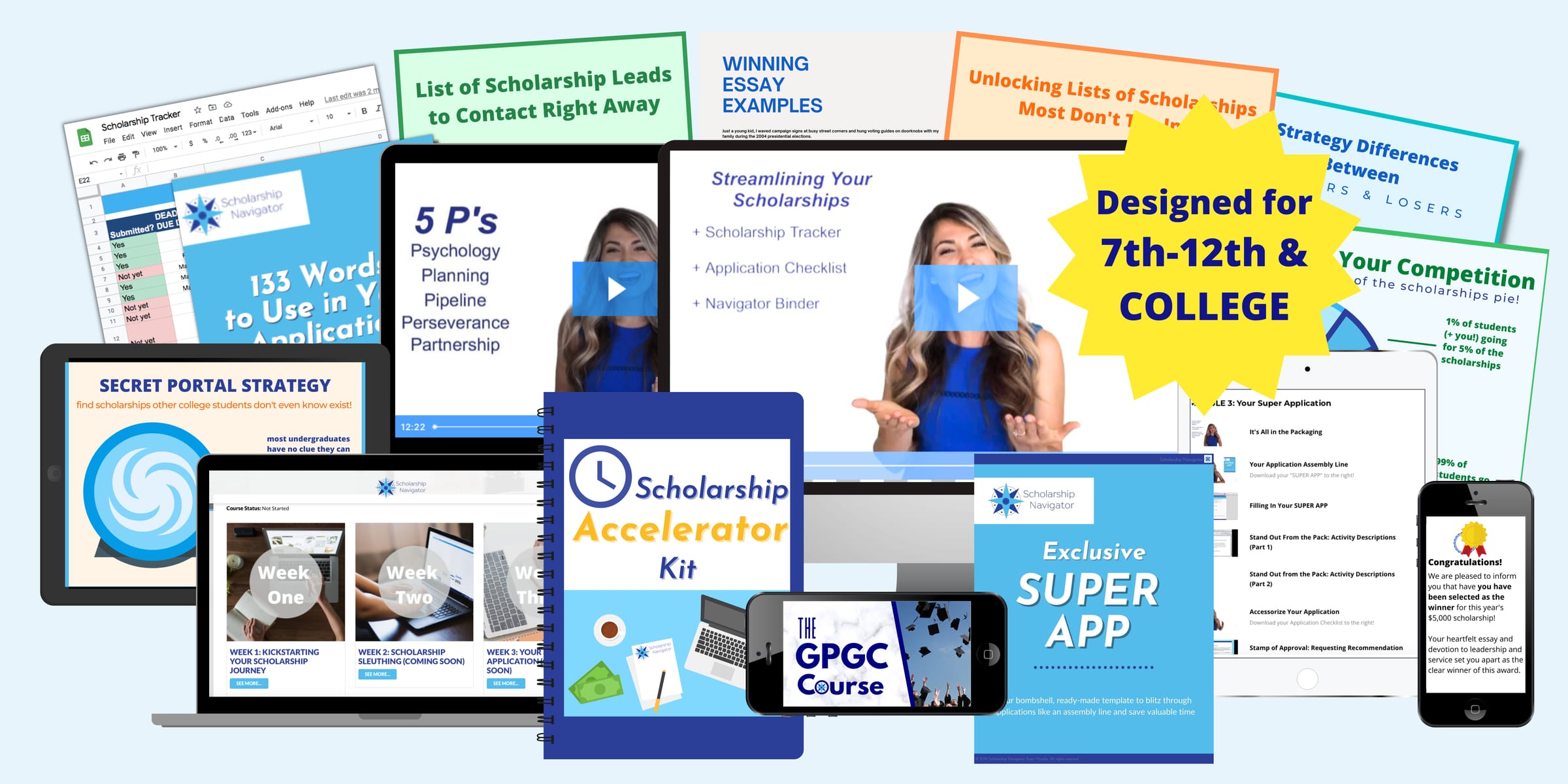
The Get Paid to Go to College Program
Turn the scholarship process into a clear, repeatable plan your family can actually follow and succeed with.
The Get Paid to Go to College Program brings Ryan’s proven scholarship-search methods and winning application strategies together into one step-by-step system, so your family knows exactly what to do to see real results.
- Find legitimate, lesser-known scholarships that fit your student
- Know which opportunities are actually worth the effort
- Build stronger applications and reuse your best work
- Follow a manageable scholarship routine instead of searching endlessly
$32K average reported first-year wins using Ryan’s strategies*
Whole-family access · Future program updates included · Designed for 7th–12th graders and college students
*Based on reported student outcomes. Individual results vary.
Want a Clearer Scholarship Strategy for Your Student?
Start with my free 30-minute class.
I’ll show you:
- where worthwhile scholarships can actually be found
- how to tell which opportunities are really worth your student’s time
- how to apply more efficiently instead of starting from scratch every time